China has never been on my to-do travel list, but when the chance to fly to
Beijing, then
Xining, then
Golmud City in the
Kunlun Mountains (moving ever deeper into the interior) came up, I thought, hell, why not? The actual reason for my visit was an invitation from the Ministry of Environmental Protection, (the EPA of the Chinese government) relating to water protection. In addition to attending a water summit in
Beijing, I conducted a water tasting for about 100 Chinese media. I mention this because since the Chinese government escorted me throughout my travels, there were things I didn’t get to see or experience, and things I will never forget. Life is, as we know, fundamentally the experience we open ourselves up to.
 |
| Part of Beijing's downtown |
Beijing is a massive city of 20 million people; a sprawling, crowded mega-city with a constant grey pall over the area.
Beijing is a global city and signs are in both Chinese and English so getting around is relatively easy, though it will take you a while to get acclimated. Of note, unless you’re a very experienced driver,
do not drive in China, even rural areas. Get a taxi or a driver as the road rules are fast and loose and with the amount of traffic you’ll get lost quickly. I was driven, for the most part, by government officials, and even they got lost! I wasn’t able to get to the
Forbidden City, sadly, though it was close to my hotel. But as I said, I was a guest of the government, and did get to see things many Westerners never experience – more on that later. Prior to my leaving for
China, many people told me that they hated
Beijing: too big, too ugly, too spread out. But as I’m a travel writer, I seek out the uniqueness of anyplace I visit. As with any city you can look at the surface and recoil, or, you can explore and dig deep.
 |
| Some of the cool art at 798 |
798 is worth exploring; an old military/industrial zone transformed into a hip urban arts and cultural center which is way cool. Art galleries, funky shops and restaurants cohabitate, juxtaposed with their military surroundings. One gallery was showing North Korean art, something we’ll never see here in the
U.S. And this is the point of not judging where you are – there are always cool, unique, unusual things just around the corner, if you only look.
 |
| A painting done by a North Korean artist |
We drove around Tiananmen Square, but were not allowed to get out and walk through it, nor see Chairman Mao’s tomb or feel the history of the student uprising in 1989 (remember the guy with the shopping bags standing in front of the tank?). Bummer, as I would have loved that. However, we were taken to the
Temple of Heaven – a sprawling series of temples started in the 1400’s, which allowed the emperors of the Ming and Qing dynasties to offer ceremonial prayers to the heavens. This is one of the quintessential experiences while in
Beijing and frankly, it’s a stunning architectural masterpiece.
 |
| Just part of the Temple of Heaven |
I was then flown to
Xining and was able to visit the
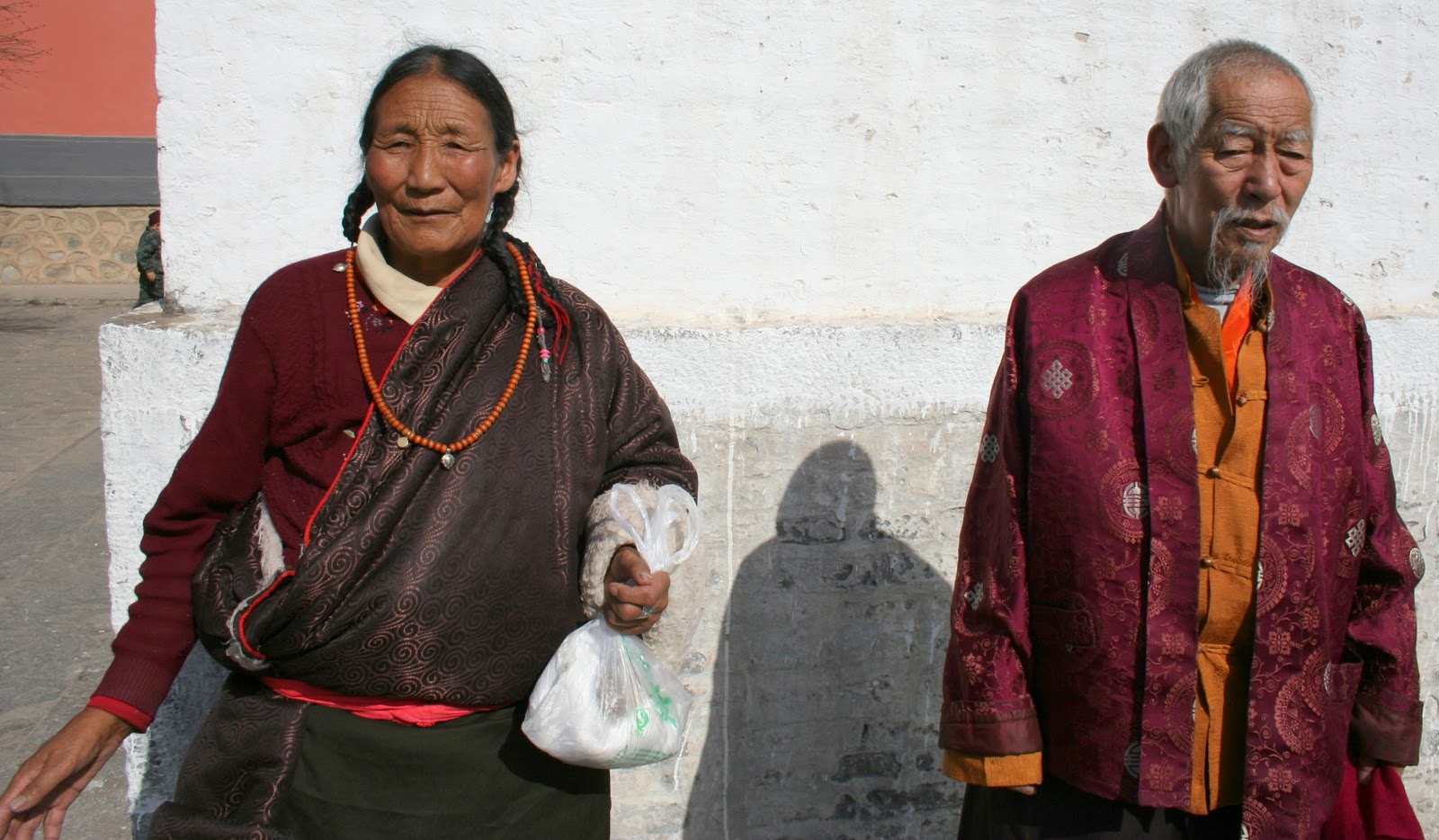
Kumbum Monastery on the Tibetan Plateau, which has 20 different temples huddled together inside its walled property; an odd mix of monks in burgundy robes, tourists staggering about with cameras banging their chests, beggars looking like they came right out of Central Casting, exhausted pilgrims, and cars all sharing the same tight space. Photos are not allowed inside the temples; therefore some of the really cool imagery is unavailable. You’ll also see some of the Mongolian people, stocky folk with ruddy earthen complexions, covered in layered garb, offering prayers as well as pilgrims.
 |
| Pilgrams inside the Kumbum Monastery |
 |
| Yes, it's real: the Temple of the Yak Butter |
Outside the walls the vendors will try and sell you anything; prayer shawls, yak yogurt, incense, cooked potatoes, and some odd worthless stuff. This is a poor area, so there is an intensity to the vendors which is off-putting, though not uncommon to many countries. If you know little about Buddhism it’s wise to do research before coming here, otherwise the imagery, icons and customs inside the monastery will be lost on you. The
Temple of the Yak Butter is the most peculiar temple I visited, devoted to all things yak (a mastodon-looking beast of burden), which has as its focal point a weirdly interesting diorama of all things Buddha made from, yes, yak butter, then painted and kept behind glass to preserve it, all hand-crafted, allegedly by the local monks. In this part of
China and at this elevation, yaks are one of the few animals able to thrive in the harsh, barren and often brutally cold environment. There are few trees, no vegetables, some wheat, barley and potatoes; therefore the yak has been elevated to near religious status. The milk, butter, meat and skins of the yak have been essential for the survival of the plateau people for thousands of years, so yeah, I guess a yak temple makes sense.
 |
| The government run Victory Hotel in Golmud |
Several nights I was ensconced comfortably in the Grand Hyatt Beijing, several other nights I stayed in government hotels, used only for the military and government personnel. The Victory, located in
Golmud City, is a peculiar building with uncomfortable beds, 1970s furniture, bad odors and people wandering about in their military uniforms. But as deep into
China as we were you actually get authentic Chinese food, not a Westernized version, including yak, sea cucumber and foods no one explained to me. But that is exactly what travel is about; preferring the actual experience to the expectation. Life is ultimately a unique adventure should we choose it and it need not always be predictable, ordinary, sanitized and flat-lined. As for my experience in
China, I would gladly go again, though it was unlike anything I had even remotely expected or hoped for.