Showing posts with label cheese. Show all posts

10.28.2011

An Open Window -- Door County, Wisconsin

Apparently, Door County, Wisconsin got its name because of a swath of water located between the tip of the peninsula (imagine a thumb jutting out from a hand…that’s Door County) and Washington Island, just north of the peninsula. These waters, due to their treacherous conditions were named by the French, Porte des Morts – “Deaths Door” (there are tons of shipwrecks which you can dive). These days the Door is less about loss of life and more about a way of life; tranquil, friendly, you know the best of the Mid-West. The peninsula is flanked by Lake Michigan and Green Bay. I always advocate that when traveling, go local. This means you need to sample local wines and beers, avoiding chain restaurants, and discover where and what the cool foods are. The region is home to seven wineries, two distilleries, local beers, cheese and cherries…lots and lots of cherries.

Sweet cherry pie!

EAT THE DOOR
There are three foods which define Door County: cheese, cherries, and fish. Cherries are what the region is best known for and you can’t throw a rock without hitting a cherry orchard (please don’t throw rocks in orchards). Therefore cherry pie is ubiquitous. I sampled cherry pie everywhere I went in the Door and found all manner of pie, using the tart Montmorency cherry. Some pies added almond paste; some had sugared crust, flaky crusts, sweet fillings, and tart-sweet fillings. I routinely make this a practice everyplace I go (biscuits and gravy in Virginia; crème brulee in Paris; quail in Texas; venison in Switzerland, etc.) and discover the amazing nuances of local versions. It’s a cool way to make your vacation more interesting.

A traditional fish boil

Boiled fish has never been a staple of my cooking; however the fish boil in Door, an aptly named food event dating back to the 1850s, uses white fish from Lake Michigan or Green Bay. The basic ingredients are fish, potatoes, onions and salt. That’s it. A large pot is brought to a boil over an open flame, salt is added, then potatoes and onions. At the end of the boil, fuel is thrown on the fire and you’ve got yourself a mini-volcano. The original fish boils happened when the oily salmon, which was more common in the olden days, would boil over and enflame the fire. With whitefish, there is no actual boil over; therefore the ending flash is enhanced by the tossing on of fuel. Fish boils are common throughout the county and a connection to history but make sure you choose a fish boil where they use real wood - some outfits use an electric burner - not accurate, not historic and kinda lame. The Square Rigger Gallery in Jacksonport does a traditional fish boil and along with your dinner, there are appetizers and, yes, cherry pie for dessert, about 20 bucks.

You can't go wrong with Wisconsin cheese

Wisconsin brags it has 51 cheese masters (super fancy cheese making people), procuring an astounding array of cheeses, and it ain’t all Colby and cheddar. Wisconsin Cheese Masters has a selection of over 90 local cheeses in one spot conveniently located just steps from Harbor Ridge Winery in Egg Harbor. There are free samples ranging from sheep, goat and cow cheeses; Goudas, merlot-soaked cheeses, chipotle and a most excellent Evalon, an aged goat cheese from LaClare Farms. Buy your cheese then walk next door to the winery and taste some wine.

DRINK THE DOOR
Harbor Ridge Winery started off as a coffee shop, then morphed into wine, perhaps an unusual transformation for Wisconsin but we all need to make a living. They make a few sweet wines on site, but buy a lot of grapes from the West Coast to make Cabernet, Merlot and Chardonnay. Orchard Country Winery makes a bushel full of fruit wines and they have an exceptional cherry wine which perfectly showcases the area. Shipwreck Brewery in Egg Harbor does a fine job of local beers and their Peninsula Porter, a dry, rich brew with toasted barley and soft mocha notes is terrific. There are the two distilleries in the Door, including Door County Distillery who make vodka, gin, and cherry infused vodka. The regular vodka is surprisingly smooth for an 80 proof and worth getting a bottle to bring home.

Some of the Harbor Ridge wines

DO THE DOOR
There are a plethora of activities in the Door, great biking paths, kayaking Lake Michigan or Green Bay, fishing, museums and half a dozen lighthouses. The Cana Island Lighthouse is one of the few which is all original. On Washington Island, a 30 minute ferry ride from the most northern point of the peninsula, you will find among the tree studded forest, not visible from the road, the Stavkirke. The what? Well, it’s a church, built entirely of wood with no nails and replicated after a similar one located in Norway, originally built in 1150 A.D. This one was constructed by volunteers between 1991 and 1995 and is a stunning piece of craftsmanship.

The impressive hand built Stavkirke
STAY
With so many choices of where to stay you want something that accentuates the Door experience. I like the Blacksmith Inn on the Shore in Bailey’s Harbor. The Inn was built in 1905 by, yes, a blacksmith. The main house has original wide plank floors, chinked walls and though the rooms are new, they have Jacuzzi tubs, gas fireplaces and every morning I watched the sunrise over Lake Michigan from my bed. They have kayaks and bikes you can use for free. The bay is just steps down a little wood walkway, a perfect place for morning coffee.
EXPLORE THE DOOR

The Blacksmith Inn on the Shore


6.23.2011

Swiss Food Bliss: Eat, Drink, Repeat


Appenzeller Cows seem quite happy

I make no apologies; I love cheese, chocolate and wine. Most people love at least one, usually two, and the genetically superior adore all three. I also love Switzerland: the Alps, the scenic beauty, the history, the orderliness of the whole system, the fact that there are only eight million people. Cheeses and chocolates are legendary here because the milk is typically un-pasteurized, (unlike for the American market) therefore the milk and cream used in the chocolates and cheeses of Switzerland are fresh, creamy and offer a textural, sensory experience.


Getting Cheesed
We know Swiss, Emmental and Gruyere cheeses, but there are 400 other varieties of cheese produced in Switzerland and it’s processed within 24 hours after milking, rendering it amazingly fresh and healthy. The Swiss consume about 35 pounds of cheese per person each year. In the Appenzell region of Northern Switzerland the main cheese is Appenzeller; aged three, six or eight months, which becomes sharper as it ages, with a creamy texture and mild nuttiness. It’s been made here for 700 years and during the aging process a blend of 42 herbs are basted on the rind, though no one will tell you exactly what they are. The secret recipe is locked in the vault of a local bank. What’s more, the highly regarded Appenzell cows (happy cows are, apparently, not from California) are taken to summer pastures 6,000 feet in the Alpine mountains where they feed on grass, (which is the way cows feed naturally, not on grain), wildflowers, herbs and other plants, therefore the multitude of cheeses have subtle taste differences.

Fondue is famously Swiss and best expressed at places like Café du Grutli in Lausanne where the blend of Gruyere and Vacherin cheeses creates a thick, smooth fondue. Owner Willi Prutsch adds tiny amounts of garlic (rubbed onto the bowl), white wine and kirsch (cherry schnapps) to his 25 year-old fondue recipe. There are also fondues with whiskey, champagne or even chile added in, so you’ll get cheesed easily.

Last Wine Standing
The best wine pairing with fondue is one of Switzerland’s most ubiquitous white wines, Chasselas, which has a mild acidity, ideal to cut the heavy cheese fondue. The simplicity of the wine and its acid brings out the sharp rich nuttiness of the cheeses. And Switzerland is home to more indigenous wine grapes than most any other country. A visit to the Lavaux wine region, hugging Lake Geneva, allows you to sample wines you cannot find anywhere else, literally, because the Swiss drink 99 percent of their wine, the other paltry one percent is exported. Odd hybrid grapes like Kerner (Riesling+Trollinger), Carminoir (Cabernet Sauvignon+ Pinot Noir) and Gamaret (Gamay+Reichensteiner) are found no where but here.

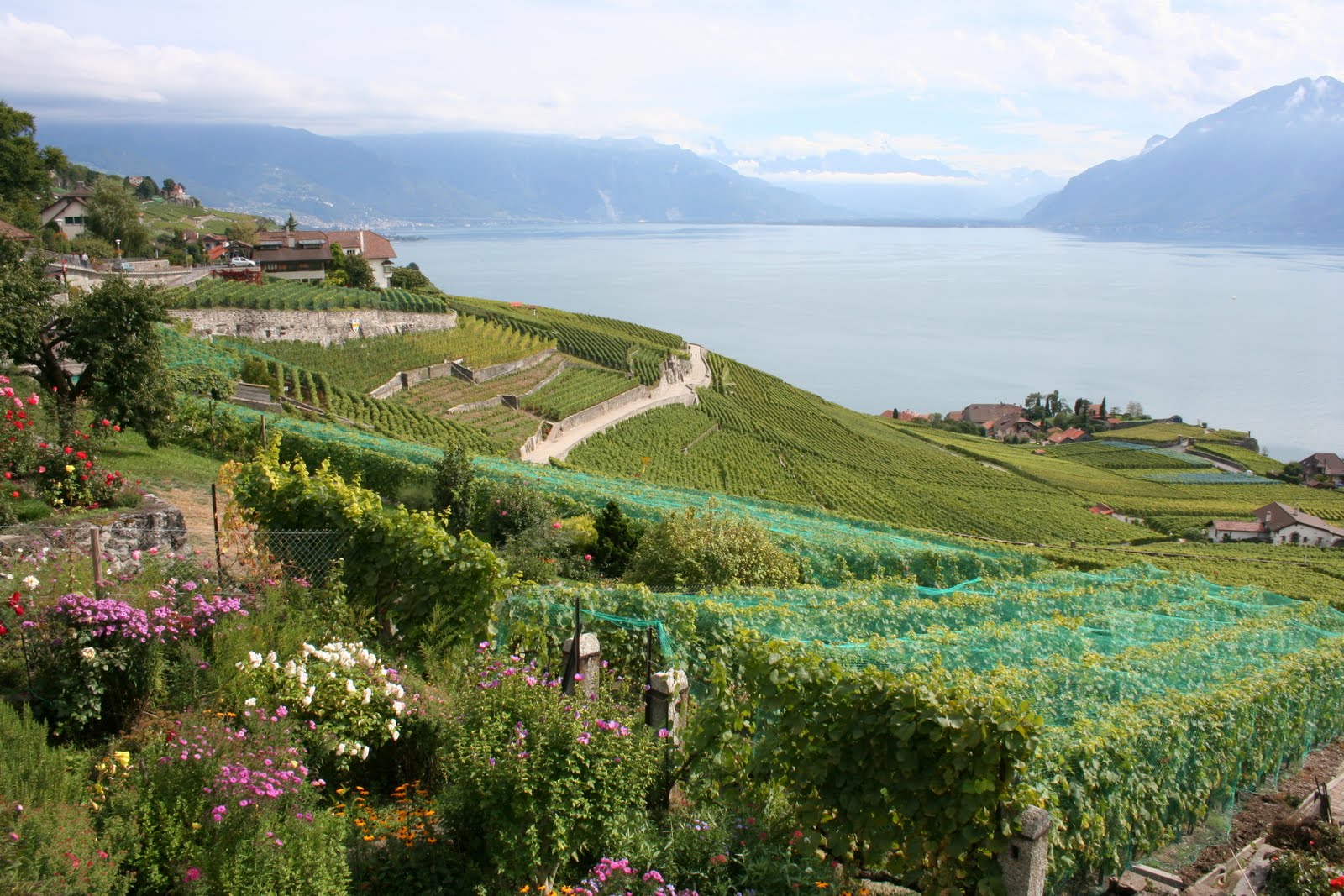
The Lavaux
Lavaux, a steep terraced shoreline is a patchwork of houses and vineyards. It’s located between Lausanne and Montreux, and this UNESCO World Heritage site is one of the most picturesque places in the entire country as the vines extend to the edge of the lake with the Alps in the background. The Romans planted the first grapes and over time the hillsides were carved out, stone walls demarcating the vineyards. The steep inclines necessitate that everything be hand harvested and each year the old stone walls must be repaired and patched less they tumble into the water. There are other wine regions in Switzerland of course, but the Lavaux is the most well-known, the quaint little Swiss villages being a post-card perfect backdrop.

Wine Villages in the Lavaux
Loco for Cocoa
Chocolate in Switzerland is ubiquitous and excellent and the Swiss consume more chocolate per person than anyone in the world, about 25 pounds annually, and no, the Swiss are not typically fat. Toblerone, Lindt and Nestle are synonymous with Swiss chocolate, but while these are good, they are mass produced and the American versions pale by comparison to the Swiss versions since they require the aforementioned pasteurized milk. In essence therefore, it’s not even the same chocolate. If you’ve eaten Toblerone in the states, compared to Switzerland, the difference is astounding. But these behemoth chocolate makers cannot equate to the medium sized chocolate makers like Teuscher (available in the U.S. and in spite of their pasteurized milk are excellent chocolates), and smaller artisanal chocolate fiends like Durig Chocolatier located in Lausanne.

Dipping your hands in chocolate...seriously, this is insane!

Dan Durig learned chocolate-making from his father and his 13 year-old eponymous store produces organic, fair trade chocolates that are stunningly good. He sources cocoa beans primarily from Ecuador and Peru and is experimenting with single variety cocoa beans, rather than blending beans together, to produce a chocolate terroir, just like with wine. As chocolate is poured into molds they are vibrated to remove any air bubbles, then embellishments with, say pink peppercorn, mango and pistachios are applied. You won’t find chocolates and cheeses that are fresher or purer than those in Switzerland, and you won’t find their wines. For those reasons alone (and frankly what other reasons do you need), a visit to this spectacular country needs to be a priority. http://www.myswitzerland.com/

Dan During