Showing posts with label switzerland. Show all posts

12.15.2016

5 Sure-Fire Tips To Help You Travel Like An Idiot


Want to travel but hate the inconvenience of dealing with other countries, their customs and language, their people and their stupid laws? This easy-to-use guide will insure you can be left alone while you travel the world exactly as you see fit.

I would never have discovered this wine!
TIP #1—Always eat and drink things you’re 100% familiar with. New foods, weird-o spices, unpronounceable ingredients? Nah, that’s a waste! Only order foods you’ve had a 1,000 times before so there’s no chance of accidentally trying anything new.
OR – When I was staying at Fairmont Montreux Palace in Switzerland I was having dinner and ordered the local duck, which came with local veggies and had a glass of wine from La Cote, a wine region near Geneva. The guy next to me, clearly an American, ordered a chicken Caesar Salad and a Heineken. Seriously, why would you prefer the mediocre to the regional food/wine/beer/coffee, etc. of the very place you’re visiting? It doesn’t mean you’ll always like it, but your palate needs new experiences too.


At the Great Wall: nǐ hǎo.
TIP #2—Never learn to greet anyone in his or her own language. Learn a few words in the country you’re visiting? Way too hard. Speak exclusively your language. That way you always understand, at least, yourself.
OR – Learn a basic greeting and how to say thank you. It opens doors, shows respect for other people and makes you cool. When I was walking the Great Wall in China I routinely said hello to people in Chinese – very simple – but very effective and if nothing else, people smiled at me and greeted me back, making my experience all the more rich.


Out of the way Moai
TIP #3—Only stick with the obvious tourist attractions. Getting off the beaten path is no doubt the surest way to get beaten up, right? Side trips are for sissies – stay with the crowds.
OR-While on Easter Island I certainly visited the main moai attractions, but I also had rented a car and seen nearly all the moai on the island because I sought them out, including several that were rarely visited, including this one near a small harbor, far from the center of town. Listed on the map? Nope.


The serene beauty of morning at Vina Vik

TIP #4—Immerse yourself in your iPhone, ear buds and laptop. There’s no need to ever look up from a travel app or unplug from your virtual world because you might miss something, right?
OR—Lose the electronics in favor of authentic experiences. On a visit to Vina Vik, a very cool boutique winery/hotel two hours south of Santiago Chile, I took a morning hike over trails on its 11,000 acres. As this pix suggests, I would not have been so captivated by the morning sun penetrating the fog if I was listening to music. Instead I heard the birds, saw the sunrise and watched the distant snow capped Andes open up before me.

Austria's pristine beauty
TIP #5 – Treat public places, parks and wildlife refuge areas like it’s your very own back yard - a place to dump everything you don’t want.
OR – Cultivate a respect for the natural world since that’s probably why you’re visiting a city or country in the first place. When I was in Austria, it was clear the people there have a profound respect for their natural surroundings, taking great pain to keep it clean. Since we humans are at the top of the food chain, it is our responsibility and obligation to treat the other animals on this planet with respect, including the natural world around us. The more you see yourself as a part of the world rather than the focus of it, your life will be much better, and so everyone else’s.


8.21.2016

Walking Geneva – The City’s Historic Sites

Geneva, Switzerland (photo: Geneva Tourism)
Geneva dates back to at least 58 BC when the Romans established it as a settlement. It finally became an independent republic in 1536, but only really gained autonomy in 1602. Filled with lots of historic sites, the majority of which are located in the Old Town, a historical walking tour can be done at your own pace and time frame as not everything is clustered together. Considering the history of Geneva it makes sense to stay at Geneva’s very first hotel, the stately neoclassical Four Seasons Hotel des Bergues, which dates to 1834. The building hosted the first assembly of the League of Nations in November 1920. There is also the Beau Rivage, which opened in 1865. Regardless of where you stay, Geneva is ripe with history…

Maison Tavel
The Maison Tavel (house of Tavel) is the oldest private residence in all of Geneva. In spite of a fire destroying it in 1334, it was rebuilt and is a classic example of medieval architecture, actually meant to identify with its original construction in the 11th Century. Currently it houses the Museum of Urban History and Daily Life of Geneva, featuring a number of relics from Geneva’s past including engravings, paintings and models. The attic contains an impressive scale model of pre-1850’s Geneva when it was still a walled city. Medieval graffiti in the basement of the house is a must see.

Pont et Tour de I’lle
A small island located in the Rhone River (directly in front of the Mandarin Oriental Hotel), this nondescript chunk of land was once a checkpoint for commuting between Northern and Southern Europe. It was accessed by bridge, however Julius Caesar destroyed the original bridge in 58 BC. A château was built here in 1219, although it too was demolished in 1677, and the tower is all that remains today of its historical past. The château was used as a prison and place of execution by the counts of Savoy.

Cafe Papon's Interior: (Photo: Cafe Papon)
Café Papon
One of the oldest cafes of Geneva, Le Café-Restaurant Papon opened in 1808. A restaurant, creperie, tearoom, and cafe, it has been hosting drinkers and diners under its vaulted ceilings and a terrace that stretches out onto the medieval fortifications of the Old Town for over 200 years. Papon has complemented its historical roots, conspicuous in the beautiful stone cellar in which it is located, with modern Swiss style. The menus draw on local, seasonal produce and if available, sample the monkfish cheeks and foie gras.

Courtyard of Hotel de Ville (photo: Geneva Tourism, Olivier Miche)
Hôtel-de-Ville
Though we define a “hotel” differently now, the original meaning included a place where kings and royalty convened. The Hotel-de-Ville in Geneva served as the seat of government as far back as the 15th Century. Its Baudet Tower, the only original structure left, was constructed in 1455 and the building has a cobblestone ramp instead of a staircase, still an architectural oddity and a unique element. Notable accomplishments of this power center; the Red Cross originated here in 1864, the first convening of the Geneva Convention occurred here, and it hosted the early meetings of the League of Nations in 1920.

The Canon and Mosaics (photo Geneva Tourism)
The Arsenal
This arcaded structure dates from 1634 and in the courtyard of the building is a cannon that was cast in 1683. It also houses several pictorial mosaic scenes, each depicting a different moment in Geneva’s history, created by Alexandre Cingria in 1949 including one illustrating Caesar's arrival in Geneva in 58 BC. There are a total of five cannon in all, which were still in commission (though never fired) up to the beginning of the 1800s. They all bear an inscription in Latin, which translates to, “light after darkness,” an homage not only to John Calvin and his impact on Geneva, but also what Switzerland has come to mean to a global population – civility and a lack of violence.

Place du Bourg-de-Four
Bourg-de-Four is the oldest square in Geneva and this spot was first a Roman forum and later a medieval town square. The Palais de Justice here was built in 1707. There is some evidence to suggest it was occupied by an East Germanic tribe in the 5th century, though not confirmed, but we do know it was once a cattle market. Today the square is made up of cafés and bars, each with umbrella-covered terraces. There is a constant hum of activity here, and the neo-classic fountain where six streets converge today was once a Roman aqueduct that brought water from the mountains to the city.

This house-museum is dedicated to the life and works of Voltaire. The museum is housed in Les Delices, which was Voltaire's home from 1755 until 1760. The property was bought by the city of Geneva in 1929, and the museum opened in 1952. It contains about 25,000 volumes on Voltaire and the 18th century as well as a collection of paintings and prints from the period, many depicting Voltaire, his relatives and acquaintances. Tours are available and the gardens are open year round.

Towering over the Old Town in the heart of the city, Saint Peter's Cathedral is Geneva's oldest and most impressive architectural treasure. The Cathedral was begun in 1160 and took over 400 years to complete, suffering numerous makeovers and fires throughout the years. The north tower offers incredible panoramic views of the city, while the basement houses an Archaeological Museum chronicling the excavation of artifacts found beneath the Cathedral, some dating back as far as 350 AD.

6.19.2016

Montreux: Half a Century of Jazz in Switzerland


Photo: c2014_ffjm-marc_ducres
I recall when I turned 50. I wasn’t impressed with my reaching five decades on Planet Earth, yet it was nonetheless something to ponder. No matter what your perspective on getting older, 50 is a milestone. Though Montreux Switzerland has roots dating to Roman times and was first mentioned in 1215, this small village of fewer than 30,000 people hosts one of the premiere music festivals in the world - the Montreux Jazz Festival. MJF is certainly the most scenic music festival, its postcard views of Lake Geneva out across to the Alps is breathtaking in every season. Turning 50 is a reason to celebrate Switzerland’s iconic jazz festival.
The Festival runs July 1 – 16th and uses 15 different venues - intimate classic jazz rooms, to larger stages for traditional performances to a host of free concerts and workshops, some even outdoors. But don’t let the word “jazz” throw you.  Sure, the early days saw legendary performers like Ella Fitzgerald, improvisational piano guru Keith Jarrett, Etta James, Chick Corea, Spyro Gyra, even Jonny Cash, Nina Simone, Fats Domino, Irish pop group The Coors, and countless others. Festival 2016 goes beyond jazz to become a celebration of the arts. The line up for 2016 includes Herbie Hancock, to Buddy Guy, but also ZZ Top, Slayer, and European groups large and small like African Acid is the Future, to hip hop, saxophonist Charles Lloyd, to guitarist Bireli Lagrene, and even DJ Shadow. There is, literally, something for everyone.


There are a number of hotels in the area and I highly recommend the LeFairmont Montreux Palace, with its waterfront setting and balconies that open up to the lake. I stayed on the 6th floor and the views, hospitality and sunsets are magnificent. Directly across the street is their lawn, one which has bronze jazz figures strewn throughout, and it’s an easy walking distance from the train so you don’t need a car assuming you fly into Geneva or Zurich.

The views from the 6th Floor
The sound of your heels on the marble floor telegraphs that you have arrived at Le Fairmont, as if the bright yellow awnings weren’t a clue. The Fairmont is at once opulent yet comfortable, refined but lived in. It has been a hotel its entire life since it opened in 1906 with the exception of being used as a hospital during both Word Wars. What’s striking about the Fairmont is that the hallways seem unreasonably wide, but this was common at the time when women wore barrel-shaped hoop skirts and women passing in a narrow hallway was simply not acceptable, nor easy. Of the 236 rooms, most offer a bathtub and separate shower and most rooms were refurbished in 2011 reflecting a slightly 1950s Moderne style. 

Along the Montreux waterfront
There are many original doors and windows from the old days with original brass fittings and lamps, chandeliers and sconces that should not be missed. On the way to the spa for example along a corridor you would normally pass by are a collections of wonderful old photos of the hotel and Montreux from the early 1900s. The original entrance to the hotel is now a parking lot entrance and the car rental service there may not know their place in history. Three restaurants are on site like the Jazz Café, and MP’s Bar & Grill, which have forgone the formality of previous years, instead they reflect a hip, trendy style with cuisine to match. There is also walking path that fronts Lake Geneva, which not only offers artworks along the path, but it’s also populated with a diversity of mature trees from Europe, Japan and Africa. No matter where you stay in Montreux, the city is postcard pretty and the Jazz Festival only adds to the allure of this ideal Swiss town.


5.28.2012

How to Travel Responsibly and Ethically


For those of us who love to travel there is perhaps no greater way to understand ourselves and our world than through the conduit of travel. But with travel comes responsibility: how can we be good travelers; responsible consumers while respecting the environment we are in, the people we are surrounded by and the culture we are immersed in? Travel is a privilege, not an entitlement, therefore when I write about travel, and appear as a guest on radio shows I always encourage a thoughtful approach. So I’ve created just a few ideas to help us travel more ethically and responsibly and be better citizens of Planet Earth:

Minimize Your Environmental Impact
~Ask your hotel if they have a recycling program (they should – recycling rates in the U.S. are an abysmal 30%! They are much better in Canada and Europe). The morning newspapers, water bottles, and soda cans should be recycled. If the hotel doesn’t have a recycle program, suggest they might consider one.
~Recycle yourself: I routinely drink bottled water when I travel because I’m not always certain of the water sources of where I’m visiting. But I also recycle those bottles – either at the hotel, or if they don’t have a recycling program, I bring the bottles back with me in my suitcase. Hassle? Nope. They weigh next to nothing and barely take up space.
~Limit your water usage: many areas around the globe are water-stressed even in Cambria, home of the Hearst Castle, water is at a premium because there’s not that much of it. You may be on vacation, but that doesn’t mean you need a long shower.
It's easy to recycle!

Respect All Wildlife
This starts with not feeding wild animals. Sure they’re cute, curious and you can get close to them, but our own crappy diet habits should not be given to animals who are not used to the ingredients (chemical or otherwise) which we consume. Feeding animals damages their health, alters their natural behaviors, and exposes them to predators and other dangers. Since Man is at the top of the food chain, we actually bear a greater responsibility to every other creature, to respect them and treat them well.
The Channel Island Fox is adorable, but he doesn't need your food

Hike, Bike,Walk
Stay on all designated trails when you hike, bike and walk. If you camp, camp on durable surfaces, and dispose of your garbage properly (especially true in parks and most especially true if you visit the Channel Islands here on the California Central Coast). So bring a bag with you and pack out exactly what you’ve packed in. I’m guessing you wouldn’t want someone to toss trash on your yard, right? Therefore treat everyplace you visit like it was your own home. It’s easy to think “I’m on vacation, so I’ll do as I please.” Well yeah, I get that idea, but it doesn’t mean our vacation is an entitlement.

Support the Local Economy
I was in Paris to run the Paris Marathon (raising money for cancer research) and part of the group I was with wanted to go to the Hard Rock Café. Mind you, I’m in Paris, home of the best food anywhere and though the Hard Rock employs local Parisians, I can go to a Hard Rock anywhere. Visit the local places where you can explore and have unique experiences. By supporting local businesses they will help the region you visit to thrive. Don’t get me wrong, large corporations have their place too, but dining at chain restaurants is far less valuable to a local economy. 
Support locals, like this farmer in Matzatlan

Many places you visit rely on tourism – even here in Santa Barbara – and I’ve seen businesses shut down because visitors shop at chain stores over local businesses. Half the fun of traveling anywhere is trying new things. I always seek out the local coffee houses, local bakeries, breweries, wineries, restaurants, distilleries and shops and stores. And in truth, some of the best finds are local and only local. While in Switzerland a while back I had a local beer with fresh venison and a potato dish called rosti; all indigenous to the specific are I was in. 
This meal, like so many, was only available where I was traveling


Ultimately treat every place you visit like it was your own backyard. My wife and I pick up trash around Santa Barbara where we live, and we do so everywhere we go, be that Spain, Paris or China. Trash is trash and if you can pick up litter on the way to visit a really cool site, you’ve done a fine thing. So have fun, travel well, learn, explore and by doing so you will continually evolve into a better person, a truly global soul who ends up being more compassionate, interesting and frankly, more cool to the people you meet
Be a good traveler, be responsible and ethical

6.23.2011

Swiss Food Bliss: Eat, Drink, Repeat


Appenzeller Cows seem quite happy

I make no apologies; I love cheese, chocolate and wine. Most people love at least one, usually two, and the genetically superior adore all three. I also love Switzerland: the Alps, the scenic beauty, the history, the orderliness of the whole system, the fact that there are only eight million people. Cheeses and chocolates are legendary here because the milk is typically un-pasteurized, (unlike for the American market) therefore the milk and cream used in the chocolates and cheeses of Switzerland are fresh, creamy and offer a textural, sensory experience.


Getting Cheesed
We know Swiss, Emmental and Gruyere cheeses, but there are 400 other varieties of cheese produced in Switzerland and it’s processed within 24 hours after milking, rendering it amazingly fresh and healthy. The Swiss consume about 35 pounds of cheese per person each year. In the Appenzell region of Northern Switzerland the main cheese is Appenzeller; aged three, six or eight months, which becomes sharper as it ages, with a creamy texture and mild nuttiness. It’s been made here for 700 years and during the aging process a blend of 42 herbs are basted on the rind, though no one will tell you exactly what they are. The secret recipe is locked in the vault of a local bank. What’s more, the highly regarded Appenzell cows (happy cows are, apparently, not from California) are taken to summer pastures 6,000 feet in the Alpine mountains where they feed on grass, (which is the way cows feed naturally, not on grain), wildflowers, herbs and other plants, therefore the multitude of cheeses have subtle taste differences.

Fondue is famously Swiss and best expressed at places like Café du Grutli in Lausanne where the blend of Gruyere and Vacherin cheeses creates a thick, smooth fondue. Owner Willi Prutsch adds tiny amounts of garlic (rubbed onto the bowl), white wine and kirsch (cherry schnapps) to his 25 year-old fondue recipe. There are also fondues with whiskey, champagne or even chile added in, so you’ll get cheesed easily.

Last Wine Standing
The best wine pairing with fondue is one of Switzerland’s most ubiquitous white wines, Chasselas, which has a mild acidity, ideal to cut the heavy cheese fondue. The simplicity of the wine and its acid brings out the sharp rich nuttiness of the cheeses. And Switzerland is home to more indigenous wine grapes than most any other country. A visit to the Lavaux wine region, hugging Lake Geneva, allows you to sample wines you cannot find anywhere else, literally, because the Swiss drink 99 percent of their wine, the other paltry one percent is exported. Odd hybrid grapes like Kerner (Riesling+Trollinger), Carminoir (Cabernet Sauvignon+ Pinot Noir) and Gamaret (Gamay+Reichensteiner) are found no where but here.

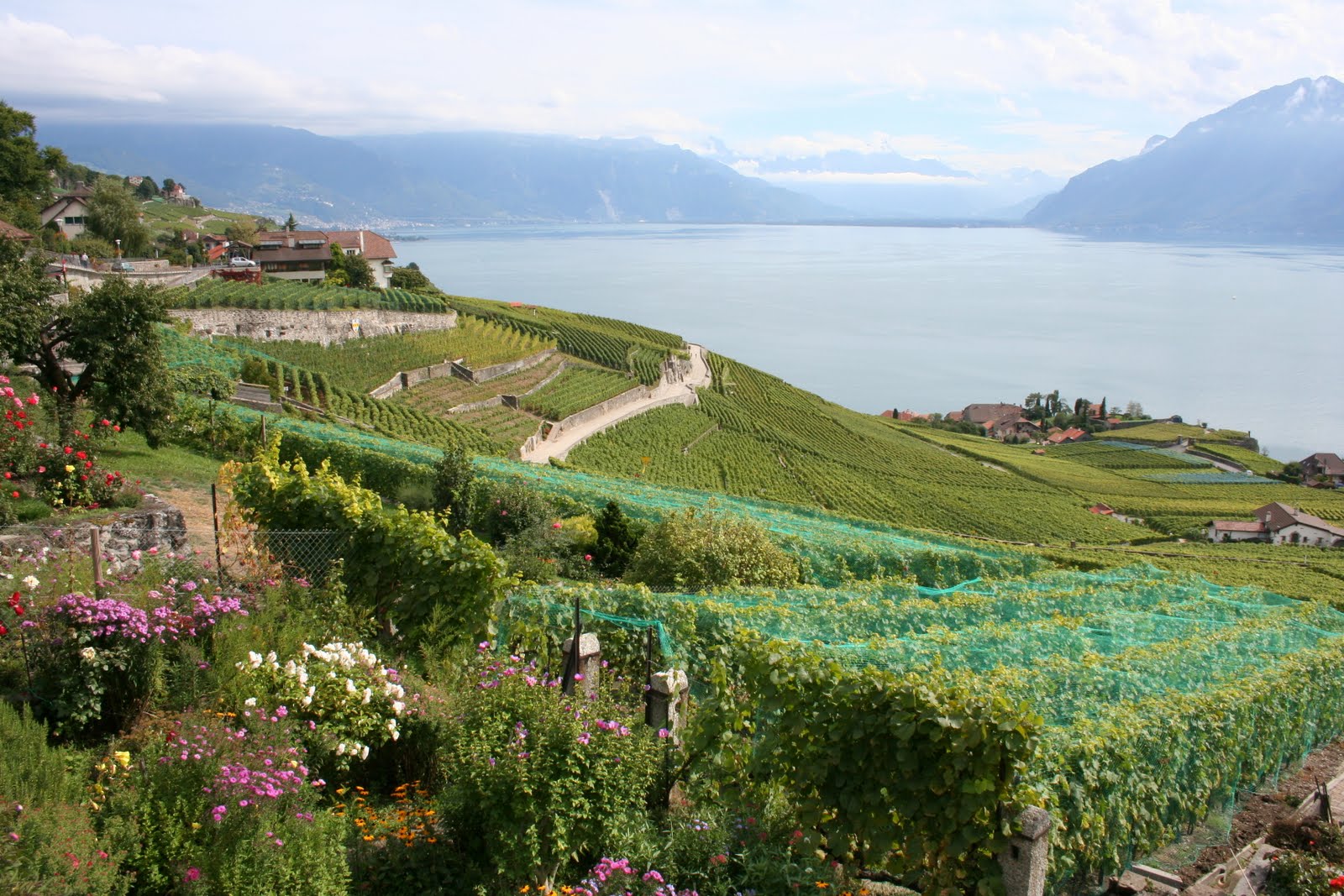
The Lavaux
Lavaux, a steep terraced shoreline is a patchwork of houses and vineyards. It’s located between Lausanne and Montreux, and this UNESCO World Heritage site is one of the most picturesque places in the entire country as the vines extend to the edge of the lake with the Alps in the background. The Romans planted the first grapes and over time the hillsides were carved out, stone walls demarcating the vineyards. The steep inclines necessitate that everything be hand harvested and each year the old stone walls must be repaired and patched less they tumble into the water. There are other wine regions in Switzerland of course, but the Lavaux is the most well-known, the quaint little Swiss villages being a post-card perfect backdrop.

Wine Villages in the Lavaux
Loco for Cocoa
Chocolate in Switzerland is ubiquitous and excellent and the Swiss consume more chocolate per person than anyone in the world, about 25 pounds annually, and no, the Swiss are not typically fat. Toblerone, Lindt and Nestle are synonymous with Swiss chocolate, but while these are good, they are mass produced and the American versions pale by comparison to the Swiss versions since they require the aforementioned pasteurized milk. In essence therefore, it’s not even the same chocolate. If you’ve eaten Toblerone in the states, compared to Switzerland, the difference is astounding. But these behemoth chocolate makers cannot equate to the medium sized chocolate makers like Teuscher (available in the U.S. and in spite of their pasteurized milk are excellent chocolates), and smaller artisanal chocolate fiends like Durig Chocolatier located in Lausanne.

Dipping your hands in chocolate...seriously, this is insane!

Dan Durig learned chocolate-making from his father and his 13 year-old eponymous store produces organic, fair trade chocolates that are stunningly good. He sources cocoa beans primarily from Ecuador and Peru and is experimenting with single variety cocoa beans, rather than blending beans together, to produce a chocolate terroir, just like with wine. As chocolate is poured into molds they are vibrated to remove any air bubbles, then embellishments with, say pink peppercorn, mango and pistachios are applied. You won’t find chocolates and cheeses that are fresher or purer than those in Switzerland, and you won’t find their wines. For those reasons alone (and frankly what other reasons do you need), a visit to this spectacular country needs to be a priority. http://www.myswitzerland.com/

Dan During