Showing posts with label chocolate. Show all posts

3.01.2012

Cocoa Fe: Chocolate in Santa Fe


In the classic children’s book, “Willy Wonka and the Chocolate Factory,” chocolate is made in a mysterious factory populated by tiny men running around who mix, stir, churn and occasionally sing about chocolate. The reality of cocoa and its origins in the U.S. is far different than some Technicolor work of fiction, but none the less entertaining. Cocoa comes from beans grown in certain parts of the world. How it came to North America first began in South America.

Cocoa Then
To go back to its origins, when Spanish explorer Hernan Cortez arrived in Vera Cruz, Mexico in 1518 he found Montezuma and his Aztec subjects drinking large quantities of chocolate, more actual cocoa than the refined chocolate we know today. There were 12 species of the cocoa plant which grew on the languid shores of Mexico, and the Spanish fell in love with it, and, as Spain conquered everything in sight, cocoa beans were sent back to Spain where they were introduced to the Europeans for the first time.
17th Century Cocoa Cup

Therefore chocolate became an integral part of the Spanish way of life in the New World and as the Missions from Texas to New Mexico and California were established chocolate became a considerable staple of everyday life. Mission documents record the important use of chocolate for prestigious guests and the padres routinely drank hot chocolate first thing in the morning. Cocoa at that time was also a valuable commodity and many storage vessels had locks on them such as shown in these photos. In fact this storage jar and cocoa cup date from the 17th century and are on display, along with a few other historical cocoa items at the New Mexico Museum of History. People covet chocolate today, and clearly they did half a century ago.
17th Century Cocoa Storage Jar

Chocolate Now
These days chocolate is imbedded into our lives is a variety of forms: hot cocoa, bittersweet, and white chocolate, to powder sprinkled on tiramisu, to a rub for meats. In Santa Fe, New Mexico, there are four chocolate shops to visit and it’s always good to know you can get hand made chocolates, truffles and other cool cocoa-inspired treats wherever you go. But, the most interesting representation of cocoa is a small shop, Kakawa, located in downtown Santa Fe. This former residence, now a store, creates individual chocolates, but most cool of all creates what they call “authentic Meso-American and historic European chocolate drinks.” Owner Tony Bennett (no, not that Tony Bennett) helms this six year-old concept. There are hardwood floors and this space is homey and comfortable where folks hang out and drink cocoa while checking email or just chatting. They roast their own red chiles used in some of the drinks (elixirs they call them) and make small batches of chocolates, and use water, not cream, to mix into their drinks as this is more historically accurate.

Bag 'O Chiles For Roasting
They use agave nectar as opposed to sugar or corn syrup because is it not only healthier, but also represents the historic reality of Mayan cultures who used agave plants in their cooking. Should you find yourself in Santa Fe, stop in to Kakawa, as they are located right downtown. Yes, the individual chocolates are very good, but I wanted to sample the drinks. Their “Zapoteca” is unsweetened cocoa, but not bitter, however it is thick and potent. Their “Chili” utilizes Ancho chilis, agave, Mexican vanilla and it hits your palate with bittersweet, then the spicy chili kicks in and slowly takes over. If you think of these drinks in terms of American hot cocoa, you’ll miss the point. These are sturdy drinks, thick and probably unlike what you’ve ever had before. And the cool thing is that you can, in a way, taste history since drinking chocolate goes back at least 500 years!
Kakawa Owner Tony Bennett

There is actually a Santa Fe chocolate trail, a loose collection of four chocolate shops, not a trail really at all. But the point is that while in this historic city, one of the oldest cities in the U.S., you can sample modern and historic iterations of chocolate. In fact, kind of interesting, When the Palace of the Governors was built in 1610 in downtown Santa Fe (and still standing mind you), it was only 92 years prior that Cortez was sipping his first cocoa drink in Vera Cruz. Should you find yourself in Santa Fe, make it a point to stop in Kakawa, as they are located right downtown. You can also check out the other chocolate places: The Chocolate Smith, C.G. Higgins, and Todos Santos

To learn about cocoa in Santa Barbara, California visit: www.CervinsCentralCoast.blogspot.com, and enjoy your cocoa!


Drink Historic Cocoa At Kakawa

6.23.2011

Swiss Food Bliss: Eat, Drink, Repeat


Appenzeller Cows seem quite happy

I make no apologies; I love cheese, chocolate and wine. Most people love at least one, usually two, and the genetically superior adore all three. I also love Switzerland: the Alps, the scenic beauty, the history, the orderliness of the whole system, the fact that there are only eight million people. Cheeses and chocolates are legendary here because the milk is typically un-pasteurized, (unlike for the American market) therefore the milk and cream used in the chocolates and cheeses of Switzerland are fresh, creamy and offer a textural, sensory experience.


Getting Cheesed
We know Swiss, Emmental and Gruyere cheeses, but there are 400 other varieties of cheese produced in Switzerland and it’s processed within 24 hours after milking, rendering it amazingly fresh and healthy. The Swiss consume about 35 pounds of cheese per person each year. In the Appenzell region of Northern Switzerland the main cheese is Appenzeller; aged three, six or eight months, which becomes sharper as it ages, with a creamy texture and mild nuttiness. It’s been made here for 700 years and during the aging process a blend of 42 herbs are basted on the rind, though no one will tell you exactly what they are. The secret recipe is locked in the vault of a local bank. What’s more, the highly regarded Appenzell cows (happy cows are, apparently, not from California) are taken to summer pastures 6,000 feet in the Alpine mountains where they feed on grass, (which is the way cows feed naturally, not on grain), wildflowers, herbs and other plants, therefore the multitude of cheeses have subtle taste differences.

Fondue is famously Swiss and best expressed at places like CafĂ© du Grutli in Lausanne where the blend of Gruyere and Vacherin cheeses creates a thick, smooth fondue. Owner Willi Prutsch adds tiny amounts of garlic (rubbed onto the bowl), white wine and kirsch (cherry schnapps) to his 25 year-old fondue recipe. There are also fondues with whiskey, champagne or even chile added in, so you’ll get cheesed easily.

Last Wine Standing
The best wine pairing with fondue is one of Switzerland’s most ubiquitous white wines, Chasselas, which has a mild acidity, ideal to cut the heavy cheese fondue. The simplicity of the wine and its acid brings out the sharp rich nuttiness of the cheeses. And Switzerland is home to more indigenous wine grapes than most any other country. A visit to the Lavaux wine region, hugging Lake Geneva, allows you to sample wines you cannot find anywhere else, literally, because the Swiss drink 99 percent of their wine, the other paltry one percent is exported. Odd hybrid grapes like Kerner (Riesling+Trollinger), Carminoir (Cabernet Sauvignon+ Pinot Noir) and Gamaret (Gamay+Reichensteiner) are found no where but here.

The Lavaux
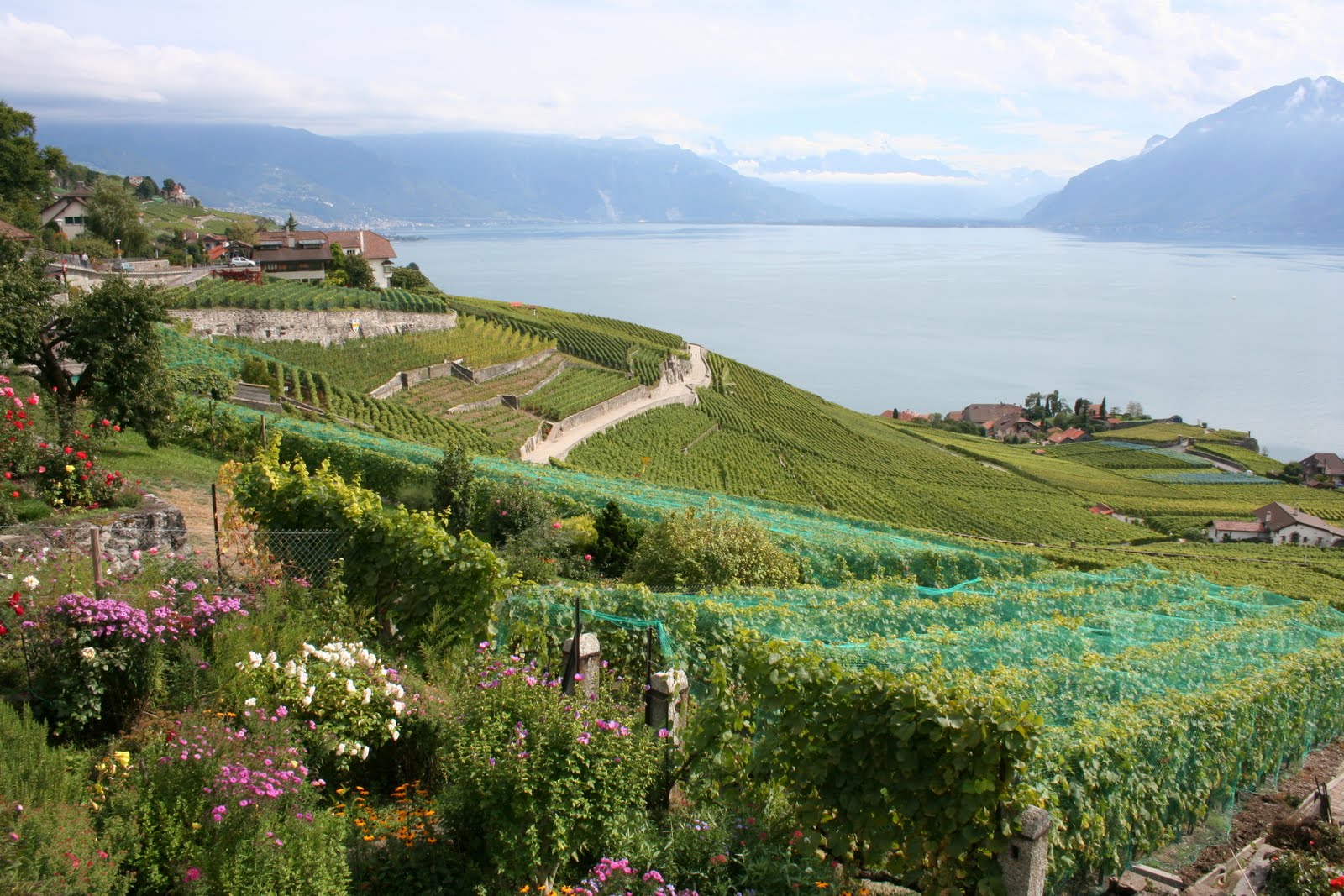
Lavaux, a steep terraced shoreline is a patchwork of houses and vineyards. It’s located between Lausanne and Montreux, and this UNESCO World Heritage site is one of the most picturesque places in the entire country as the vines extend to the edge of the lake with the Alps in the background. The Romans planted the first grapes and over time the hillsides were carved out, stone walls demarcating the vineyards. The steep inclines necessitate that everything be hand harvested and each year the old stone walls must be repaired and patched less they tumble into the water. There are other wine regions in Switzerland of course, but the Lavaux is the most well-known, the quaint little Swiss villages being a post-card perfect backdrop.

Wine Villages in the Lavaux
Loco for Cocoa
Chocolate in Switzerland is ubiquitous and excellent and the Swiss consume more chocolate per person than anyone in the world, about 25 pounds annually, and no, the Swiss are not typically fat. Toblerone, Lindt and Nestle are synonymous with Swiss chocolate, but while these are good, they are mass produced and the American versions pale by comparison to the Swiss versions since they require the aforementioned pasteurized milk. In essence therefore, it’s not even the same chocolate. If you’ve eaten Toblerone in the states, compared to Switzerland, the difference is astounding. But these behemoth chocolate makers cannot equate to the medium sized chocolate makers like Teuscher (available in the U.S. and in spite of their pasteurized milk are excellent chocolates), and smaller artisanal chocolate fiends like Durig Chocolatier located in Lausanne.

Dipping your hands in chocolate...seriously, this is insane!

Dan Durig learned chocolate-making from his father and his 13 year-old eponymous store produces organic, fair trade chocolates that are stunningly good. He sources cocoa beans primarily from Ecuador and Peru and is experimenting with single variety cocoa beans, rather than blending beans together, to produce a chocolate terroir, just like with wine. As chocolate is poured into molds they are vibrated to remove any air bubbles, then embellishments with, say pink peppercorn, mango and pistachios are applied. You won’t find chocolates and cheeses that are fresher or purer than those in Switzerland, and you won’t find their wines. For those reasons alone (and frankly what other reasons do you need), a visit to this spectacular country needs to be a priority. http://www.myswitzerland.com/

Dan During